
Cloud Computing Architecture: The Backbone of Modern Digital Infrastructure
As modern enterprises increasingly migrate their operational workloads, software environments, and sensitive data to remote infrastructures, the underlying digital framework becomes critical. At the core of this technological shift lies cloud computing architecture. Without a meticulously engineered architectural foundation, the core advantages of cloud ecosystems—such as dynamic scalability, structural flexibility, and on-demand resource provisioning—would remain entirely unattainable. This comprehensive guide explores the structural anatomy, key components, operational models, and future trajectory of cloud computing architecture.
Understanding this architecture is vital for organizations seeking to optimize performance, harden security parameters, and harness cutting-edge technology to drive sustainable growth.
What is Cloud Computing Architecture?
Defining the Structural Framework
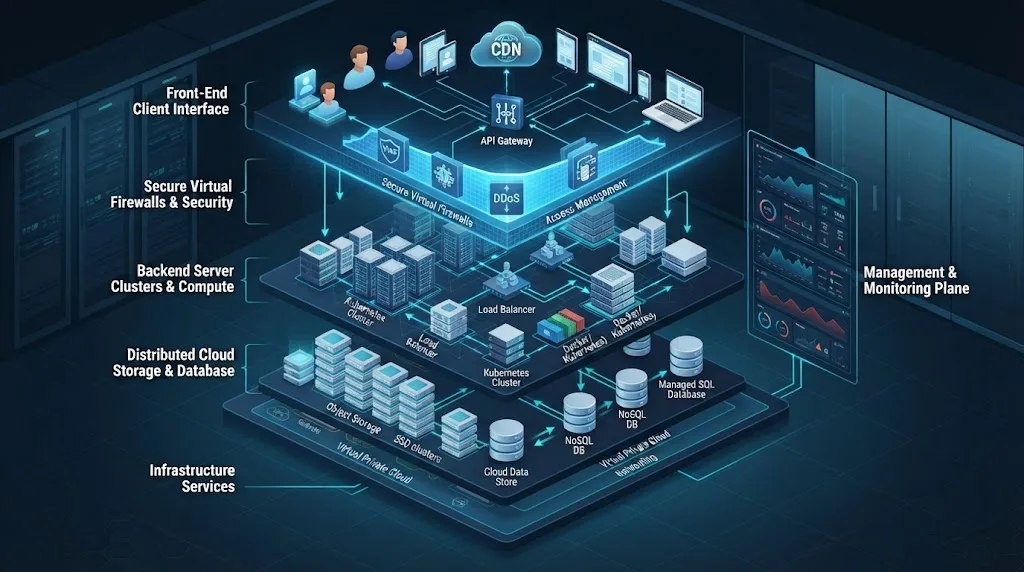
At its technical core, cloud computing architecture describes the meticulously organized layout of hardware components, network configurations, operating systems, and middleware that collectively deliver seamless cloud services. Acting as the blueprint for digital transformation, this architecture ensures that disparate systems—ranging from virtualized servers to advanced distributed databases—interoperate efficiently and securely.
The Core Function of Structural Design
The architecture serves as the operational engine supporting modern software solutions and decentralized applications. By abstracting physical hardware constraints, it allows engineers to deploy, manage, and scale applications remotely, ensuring uninterrupted business performance across global networks.
Key Components of Cloud Computing Architecture
Front-End and Back-End Synergy
Cloud systems are conceptually divided into two primary tiers:
- The Front-End: Encompasses client-facing interfaces, web browsers, and user-friendly mobile applications that enable end-users to interact with the cloud environment.
- The Back-End: Functions as the heavy-lifting engine, consisting of powerful data servers, centralized databases, and auxiliary software repositories that process, analyze, and store data securely.
Advanced Cloud Storage Systems
Scalable cloud storage eliminates the financial and logistical burden of maintaining physical hard drives on-premises. By distributing information across fault-tolerant server clusters, organizations achieve high durability and rapid data retrieval speeds.
Comprehensive Cloud Service Models
Modular service layers form the backbone of the architecture, categorized primarily into Infrastructure-as-a-Service (IaaS), Platform-as-a-Service (PaaS), and Software-as-a-Service (SaaS). These layers allow development teams to build, test, and run applications without managing underlying hardware.
Architectural Models: Public, Private, and Hybrid
Public Cloud Infrastructure
In a public model, third-party providers own and maintain all computing hardware, delivering shared resources over public networks. This model offers high cost-efficiency and rapid deployment capabilities for rapidly scaling organizations.
Private Cloud Environments
Dedicated entirely to a single enterprise, private architectures offer maximum control, isolation, and custom security configurations. They are heavily utilized by institutions dealing with stringent regulatory mandates, such as financial establishments and healthcare providers.
Hybrid Cloud Strategies
A hybrid configuration bridges public and private environments, allowing workloads to move fluidly between them based on security needs, performance demands, and cost considerations.
Ensuring Security and High Performance
Robust Security Frameworks
Safeguarding data integrity requires multi-layered defense mechanisms. Modern architectures integrate advanced encryption protocols, granular access control lists, network firewalls, and automated disaster recovery backups to mitigate cyber threats.
Performance Optimization and Load Balancing
By distributing incoming computational workloads across multiple server nodes, cloud architectures prevent bottlenecks, guaranteeing high availability and reliability even during traffic spikes.
Future Horizons in Cloud Architecture
The evolution of cloud frameworks continues to accelerate with the integration of edge computing and artificial intelligence. Edge computing processes data closer to the source of generation to reduce latency, while artificial intelligence algorithms optimize real-time resource allocation and automated maintenance workflows.
Conclusion
Cloud computing architecture represents the invisible engine propelling digital innovation forward. By delivering unmatched scalability, stringent security, and flexible operational frameworks, it empowers modern enterprises to thrive in an increasingly competitive technological landscape.
Frequently Asked Questions (FAQs)
- What is cloud computing architecture?
- It is the structured arrangement of hardware, networks, and software components that work together to deliver reliable cloud services.
- What are the primary cloud architectural models?
- The three primary models are public clouds, private clouds, and hybrid configurations, each serving distinct operational and security needs.
- Why is scalability crucial in cloud design?
- Scalability allows organizations to dynamically adjust computing power and storage capacity in response to real-time workload demands.
- How does the architecture maintain data security?
- It employs end-to-end encryption, strict user authentication, perimeter firewalls, and redundant backup systems to prevent data loss.
- What role do emerging technologies play in future cloud architectures?
- Technologies like artificial intelligence and edge computing optimize automated resource management, reduce latency, and enhance real-time data processing.